


 Distributors
  SDS Download
  Contact
 Partner Login
Enter your username and password here on order to log in on the partner portal:
No registered partner yet?
Register now2026 Best Custom Stainless Steel Coil Supplier?
Choosing the 2026 Best Custom Stainless Steel Coil Supplier requires more than comparing prices. A reliable supplier must connect metallurgy, processing control, and practical application knowledge. Grade 304 may suit food equipment, while 316L often performs better near chlorides and marine exposure. Thickness, width, temper, surface finish, edge condition, and slitting tolerance also affect the final result.
Quality authority W. Edwards Deming said, “Quality comes not from inspection, but from the improvement of the production process.” That principle matters when evaluating a Custom Stainless Steel Coil manufacturer. Ask for heat numbers, mill test certificates, chemical analysis, mechanical results, and production records. Check whether the supplier can maintain stable tolerances across every coil, not only one attractive sample. A clean warehouse helps. So does traceable packaging.
Details reveal experience.
The strongest suppliers explain their annealing process, cold-rolling controls, surface finishing, and corrective-action procedures. They should discuss 2B, BA, No. 4, or customized finishes without vague promises. Lead time deserves equal attention. A low quotation becomes expensive when coils arrive late, poorly protected, or outside specification.
Still, no comparison is perfect. Forecasts change, raw-material prices move, and a supplier may perform differently across grades. A trial order is wiser than a rushed annual contract. Measure flatness, surface quality, hardness, and dimensional consistency after delivery. Then review the evidence honestly. The best 2026 supplier is not necessarily the largest company. It is the partner that documents its claims, understands your forming process, and improves when something goes wrong.
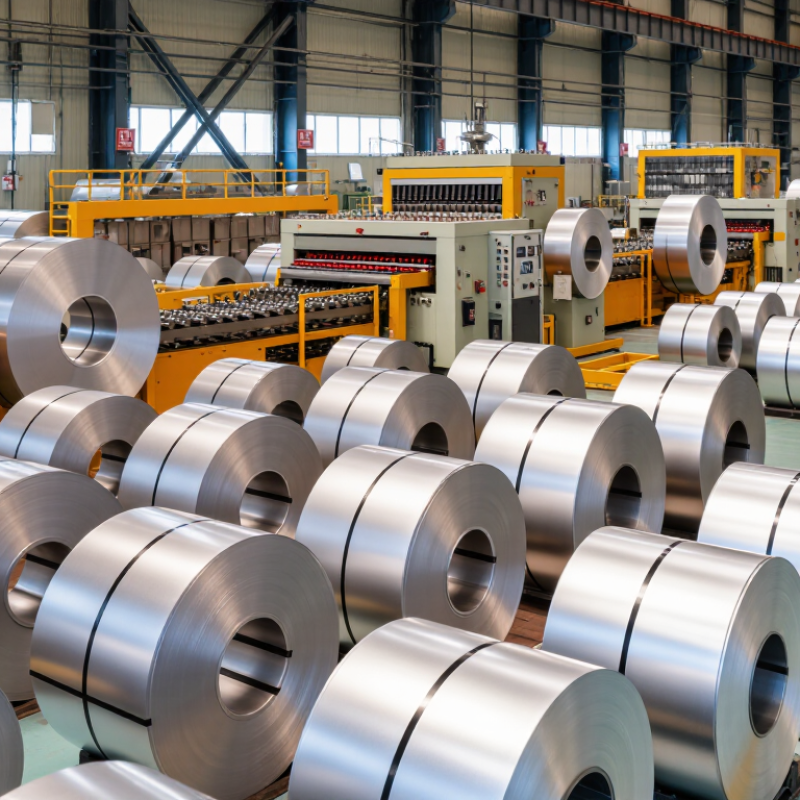
What Defines a Custom Stainless Steel Coil Supplier in 2026?
What Defines a Custom Stainless Steel Coil Supplier in 2026?
A custom stainless steel coil supplier does more than cut standard material. It translates drawings, service conditions, and production risks into a controlled coil specification. World Stainless reported about 62.6 million tonnes of global crude stainless steel production in 2024. That scale makes reliable customization more important, not less.
Experience appears in small details. A capable supplier records heat numbers, grade chemistry, thickness tolerance, width, edge condition, surface finish, and coil weight. It should provide mill certificates and practical test data, including tensile strength, hardness, corrosion performance, and surface inspection results. ASTM and EN references must match the buyer’s application, not merely decorate a quotation. The supplier should also explain slitting limits, welding effects, packaging, and realistic lead times. Fast promises can hide weak planning.
Carbon reporting now deserves closer attention. The International Energy Agency has identified industrial emissions and material efficiency as continuing priorities in heavy industry. Therefore, buyers may request recycled content, production emissions, energy data, and traceability records. Data quality varies. I would question every impressive sustainability claim.
A dependable partner keeps samples, inspection images, and corrective-action records. It can adjust a 0.8-millimetre coil after a forming trial, without blaming the customer. That human response matters. Digital systems help, but judgment still decides whether a specification works on the factory floor.
| Evaluation Dimension | Practical 2026 Benchmark | Relevant Standards or Documents | What a Custom Supplier Should Provide | Why It Matters to Buyers |
|---|---|---|---|---|
| Material Grade Selection | 304/304L, 316/316L, 430, and other application-specific grades | ASTM A240; EN 10088-2; applicable customer specifications | Grade recommendations based on corrosion exposure, temperature, forming requirements, welding, and end use | Correct grade selection reduces premature corrosion, production failures, and unnecessary material costs |
| Thickness Capability | Typical cold-rolled coil programs commonly cover approximately 0.20–3.00 mm; actual capability varies by mill and product | ASTM A480/A480M; EN 10051; approved purchase specification | Confirmed thickness tolerance, minimum order quantity, available coil weight, and production limitations | Accurate thickness control supports stamping, bending, deep drawing, fabrication, and dimensional consistency |
| Width Customization | Slit widths or master coils matched to the customer’s processing equipment | ASTM A480/A480M; EN 10051; customer drawings | Width tolerance, edge condition, slit-edge quality, burr limits, and recoiling requirements | Correct width minimizes trim waste and improves line efficiency |
| Surface Finish | 2B, BA, No. 3, No. 4, or other agreed finishes, subject to grade and thickness availability | ASTM A480/A480M; EN 10088-2; customer-approved samples | Surface-finish description, roughness target where required, protective film options, and sample approval | Surface consistency affects appearance, cleanability, coating performance, and downstream polishing |
| Dimensional Tolerances | Tolerances stated explicitly for thickness, width, flatness, camber, and coil shape | ASTM A480/A480M; EN 10051; project-specific tolerances | Inspection reports showing actual measurements against the agreed specification | Clear tolerances reduce disputes and ensure compatibility with automated equipment |
| Mechanical Properties | Yield strength, tensile strength, elongation, and hardness reported by heat or lot when specified | ASTM A240; EN 10088-2; applicable grade requirements | Mill test certificate with chemical composition and mechanical test results | Verified properties help confirm formability, strength, and suitability for fabrication |
| Traceability | Heat number, coil number, grade, dimensions, and production records traceable to delivered material | Mill test certificate; quality management procedures; customer traceability requirements | Permanent marking or labels, packing-list references, and document-to-coil matching | Traceability supports recalls, audits, quality investigations, and regulated applications |
| Corrosion Resistance Verification | Material chemistry and grade confirmed; additional testing agreed when the application requires it | ASTM A262 for certain intergranular corrosion practices; project-specific testing requirements | Test scope defined before production, with results linked to the relevant heat or lot | Testing should reflect the actual service environment rather than relying only on a grade name |
| Quality Management | Documented quality system with controlled inspection, nonconformance, and corrective-action processes | ISO 9001 certification or equivalent documented quality controls | Current certificate or audit evidence, inspection plan, sampling method, and corrective-action records when requested | A controlled quality system improves repeatability across recurring custom orders |
| Sample and Approval Process | Production sample or reference sample approved before full-volume manufacture when finish or tolerance is critical | Customer drawings, approved limit samples, inspection criteria | Sample dimensions, surface comparison, test results, and written approval records | Early approval prevents costly misunderstandings about appearance and fit |
| Processing Services | Slitting, cut-to-length, edge conditioning, recoiling, leveling, or protective-film application as required | Customer process specification; agreed inspection criteria | Defined processing tolerances, equipment limitations, packaging method, and subcontracting disclosure where applicable | Integrated processing can reduce handling, lead time, and material waste |
| Packaging and Handling | Moisture-resistant, edge-protective packaging suitable for the transport route and storage period | Customer packaging specification; transport and export requirements | Coil orientation, eye protection, separators, labeling, corrosion protection, and loading photos when needed | Proper packaging reduces edge damage, staining, deformation, and transit-related claims |
| Lead-Time Reliability | A written schedule covering technical confirmation, raw-material sourcing, production, inspection, and dispatch | Purchase order; production schedule; agreed delivery terms | Milestone updates, delay-notification procedure, and realistic capacity-based delivery dates | Reliable scheduling helps buyers plan manufacturing and maintain inventory continuity |
| Order Flexibility | Ability to handle custom combinations of grade, thickness, width, finish, coil weight, and documentation | Customer technical specification; quotation and order confirmation | Transparent minimum order quantities, setup charges, trial-order options, and repeat-order controls | Flexibility is essential for prototypes, small batches, and products with multiple dimensions |
| Technical Communication | Fast, precise responses supported by drawings, tolerance tables, sample images, and written clarifications | Technical data sheet; approved drawings; inspection plan | A designated technical contact who can confirm metallurgy, processing, quality, and documentation requirements | Clear communication prevents specification errors before production begins |
| Total Cost of Ownership | Evaluation based on material price, yield, processing, freight, packaging, inspection, defects, and rework | Detailed quotation; agreed Incoterms; quality and packaging specifications | Line-item pricing, surcharge assumptions, freight basis, payment terms, and warranty or claim procedure | The lowest unit price may not be the lowest overall cost when waste or quality risk is included |
