


 Distributors
  SDS Download
  Contact
 Partner Login
Enter your username and password here on order to log in on the partner portal:
No registered partner yet?
Register now2026 Best Pipe Elbow Manufacturers for Global Buyers?
Selecting the 2026 best Pipe Elbow manufacturers requires more than comparing catalog prices. Global buyers need proven forming quality, traceable materials, and dependable delivery.
The global pipe fittings market continues to benefit from energy, water, chemical processing, and infrastructure investment. Grand View Research identifies industrial expansion and pipeline development as major market drivers. Fortune Business Insights also reports steady demand for forged and fabricated fittings across oil, gas, construction, and process industries. These reports offer useful direction, but they do not replace factory-level verification.
A reliable manufacturer should demonstrate compliance with ASME B16.9, ASME B16.28, ASTM, EN, or equivalent specifications. Buyers should inspect mill test certificates, heat numbers, dimensional reports, and hydrostatic or non-destructive testing records. A 90-degree elbow may look simple. Its radius, wall thickness, bevel, and weld preparation affect installation and service life.
This guide evaluates manufacturers through practical evidence. It considers production capacity, stainless steel and carbon steel options, corrosion resistance, customization, quality control, and export experience. It also examines response speed and packaging, because damaged bevels can delay an entire project.
Some supplier claims remain difficult to verify online. That matters. Factory audits, sample testing, and reference checks provide stronger evidence than polished brochures. Buyers should also review lead times under real production conditions, not only quoted delivery dates. The best supplier is not always the cheapest one. A lower purchase price can become expensive after rework, leakage, or schedule disruption. Therefore, this 2026 selection focuses on measurable performance, transparent documentation, and long-term buyer confidence.
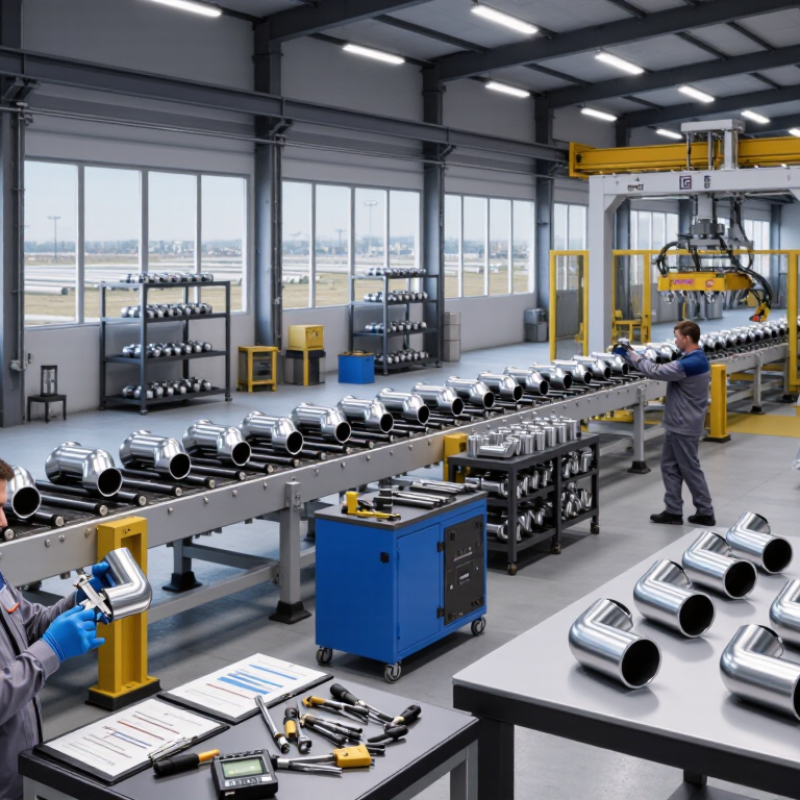
Types of Pipe Elbows and Their Global Industrial Applications
Pipe elbows guide fluids around corners while controlling pressure loss, vibration, and installation space. The main types include 45-degree, 90-degree, and 180-degree elbows. Long-radius elbows reduce turbulence and suit high-flow process lines. Short-radius elbows save space but create greater resistance. Reducing elbows connect different pipe diameters without adding another fitting.
Industrial applications vary by material and connection method. Carbon steel elbows often serve water, steam, and general process systems. Stainless steel options resist corrosion in food, chemical, and pharmaceutical facilities. Alloy elbows handle elevated temperatures and demanding pressure cycles. Butt-weld elbows provide strong, continuous joints for pipelines, while threaded and socket-weld designs support smaller utility lines. Plastic elbows are useful in selected drainage and chemical applications, but temperature limits need careful review.
Tips: Match the elbow angle, radius, material, wall thickness, and pressure class with the complete piping system. Check dimensional standards and traceable test documents before purchase. Inspect bevels, surface finish, marking, and packing conditions. A visually clean fitting may still have incorrect chemistry or wall thickness. Field measurements can expose drawing errors. Do not ignore them. One practical weakness remains: buyers sometimes compare unit price only. Installation time, weld preparation, corrosion allowance, and replacement access can change the real cost significantly. Local operating temperatures and fluid properties should guide the final selection.
2026 Best Pipe Elbow Manufacturers for Global Buyers? - Types of Pipe Elbows and Their Global Industrial Applications
Buyer-oriented comparison of common pipe elbow designs, typical specifications, applicable standards, manufacturing routes, and industrial uses. Actual dimensions, pressure ratings, materials, and testing requirements should be confirmed against the project specification and applicable standard.
| Pipe Elbow Type | Common Angle | Typical Size Range | Typical Manufacturing Method | Common Materials | Connection Ends | Typical Standards | Hydraulic and Flow Characteristics | Global Industrial Applications | Key Buyer Checks |
|---|---|---|---|---|---|---|---|---|---|
| 90° Long-Radius Elbow | 90° | Approximately DN15–DN1200; NPS 1/2–48 | Hot induction bending, hot forming, or seamless/welded fabrication | Carbon steel, stainless steel, low-alloy steel, duplex stainless steel, nickel alloys | Butt-weldFlangedGrooved | ASME B16.9, ASME B16.28, EN 10253, MSS SP-75 | Lower pressure loss and lower turbulence than short-radius designs; suitable for general directional changes | Oil and gas transmission, chemical processing, water treatment, power generation, industrial utilities | Outside diameter, wall thickness, center-to-end dimension, bend radius, material grade, impact testing, NDE level |
| 90° Short-Radius Elbow | 90° | Approximately DN15–DN600; NPS 1/2–24 | Hot forming, forging for smaller sizes, or fabricated construction for large sizes | Carbon steel, stainless steel, alloy steel, ductile iron, nickel alloys | Butt-weldThreadedFlanged | ASME B16.9, ASME B16.11 for forged fittings, EN 10253 | Compact installation footprint but higher turbulence and pressure drop than long-radius elbows | Compact process skids, plant piping, maintenance modifications, equipment connections, low-space utility systems | Confirm allowable pressure drop, minimum wall thickness, clearance, erosion risk, and fatigue requirements |
| 45° Elbow | 45° | Approximately DN15–DN1200; NPS 1/2–48 | Induction bending, hot forming, or fabricated segmented construction | Carbon steel, stainless steel, alloy steel, duplex stainless steel, plastic-lined steel | Butt-weldFlangedGrooved | ASME B16.9, EN 10253, MSS SP-75 | Generally produces less directional loss than a 90° elbow; useful where gradual routing is possible | Water pipelines, HVAC systems, refinery piping, food and beverage services, mining slurry systems | Check bend radius, flow direction, internal surface finish, corrosion allowance, and installation alignment |
| 180° Return Bend | 180° | Approximately DN15–DN600; NPS 1/2–24 | Hot forming, induction bending, or two-elbow assembly | Carbon steel, stainless steel, alloy steel, copper alloys | Butt-weldFlanged | ASME B16.9, EN 10253, project-specific fabrication standards | Creates a complete flow reversal; requires careful support and may increase pressure loss and vibration | Heat exchangers, boiler piping, U-shaped process loops, thermal circulation systems, compact return lines | Evaluate thermal expansion, support spacing, vibration, drainability, venting, and cleaning access |
| Mitered Elbow | Custom angles, commonly 30°, 45°, 60°, or 90° | Commonly DN200 and above; larger diameters are project-dependent | Cut pipe segments joined by circumferential welding; often shop-fabricated | Carbon steel, stainless steel, alloy steel, lined steel | WeldedFlanged assembly | ASME B31.1/B31.3 design requirements, EN 13480, project fabrication specifications | Economical for large diameters but may generate greater turbulence and local stress than formed elbows | Large-diameter water conveyance, cooling-water systems, air ducts, low-pressure industrial piping, infrastructure projects | Require engineered stress analysis, weld procedure qualification, reinforcement design, and full dimensional inspection |
| Forged Socket-Weld Elbow | 45° or 90° | Commonly DN15–DN100; NPS 1/2–4 | Closed-die forging followed by machining and heat treatment | Carbon steel, stainless steel, alloy steel, nickel alloys | Socket-weld | ASME B16.11, MSS SP-79, MSS SP-83, MSS SP-95 | Compact and strong for small-bore piping; socket geometry requires attention to thermal expansion and crevice corrosion | Instrumentation, chemical dosing, steam, high-pressure utility lines, hydraulic systems, power-plant auxiliary piping | Check pressure class, bore configuration, socket depth, material traceability, and welding clearance |
| Forged Threaded Elbow | 45° or 90° | Commonly DN6–DN100; NPS 1/8–4 | Closed-die forging and precision threading | Carbon steel, stainless steel, malleable iron, brass, nickel alloys | NPTBSPTBSPP | ASME B16.11, ASME B1.20.1, ISO 7-1, EN 10241 | Easy to install on small-bore lines; threaded joints may be less suitable for severe vibration or high cyclic temperature | Compressed air, water services, general utilities, low-to-medium pressure instrument connections, maintenance piping | Confirm thread form, pressure-temperature rating, sealant compatibility, galvanic corrosion, and local code acceptance |
| Butt-Weld Reducing Elbow | 45° or 90° | Commonly DN25–DN600; NPS 1–24 | Hot forming, cold forming for selected sizes, or engineered fabrication | Carbon steel, stainless steel, alloy steel, duplex stainless steel | Butt-weld | ASME B16.9, EN 10253, MSS SP-75 | Combines directional change and diameter reduction; can reduce the number of welds and fittings in a layout | Process plants, pump discharge lines, compressor piping, chemical transfer systems, petrochemical facilities | Check concentric or eccentric configuration, reducer orientation, flow velocity, wall-thickness transition, and stress loading |
| Sanitary Clamp Elbow | 45°, 90°, or 180° | Commonly tube OD 12.7–323.9 mm; project-specific larger sizes available | Precision tube forming, polishing, orbital-weld fabrication, or investment casting | 304/304L stainless steel, 316/316L stainless steel, electropolished stainless steel | Tri-clampButt-weldOrbital-weld | ASME BPE, 3-A sanitary requirements, ISO 2852, DIN 11850/11851 where specified | Smooth internal surfaces support cleanability and reduce product retention; sanitary design prioritizes drainage and hygienic joining | Pharmaceutical manufacturing, biotechnology, dairy processing, breweries, cosmetics, food and beverage plants | Specify surface roughness, electropolishing, internal weld treatment, elastomer grade, drainability, and documentation |
| Plastic Thermoplastic Elbow | 45° or 90° | Commonly DN15–DN1000; NPS 1/2–40 depending on polymer and joining method | Injection molding, extrusion forming, or fabricated thermoplastic construction | PVC, CPVC, HDPE, PP, PVDF, PTFE-lined constructions | Solvent-weldButt-fusionElectrofusionFlanged | ASTM D2466, ASTM D3261, ISO 15494, ISO 4427, EN ISO 1452 where applicable | Low friction and strong corrosion resistance; pressure capacity varies significantly with temperature and polymer type | Water treatment, corrosive chemical drainage, semiconductor utilities, irrigation, mining, wastewater, industrial process lines | Check temperature derating, chemical compatibility, UV exposure, joining procedure, SDR/pressure class, and thermal expansion |
| Lined or Internally Coated Elbow | 45° or 90° | Commonly DN25–DN1000; NPS 1–40 | Steel elbow with PTFE, rubber, fluoropolymer, ceramic, or other engineered lining/coating | Carbon steel substrate with PTFE, PFA, rubber, polyurethane, ceramic, or specialty coatings | FlangedButt-weld with loose lining system | ASTM F1545, ASTM D5162, EN 14879, project-specific lining specifications | Provides corrosion or abrasion protection but may have temperature, vacuum, permeation, and lining-thickness limitations | Acid handling, chlor-alkali plants, mineral processing, slurry transport, wastewater, chemical storage and transfer | Verify lining continuity, spark testing, vacuum rating, flange face dimensions, permeability, abrasion resistance, and repair method |
Global buyer selection checklist: Confirm nominal size, outside diameter, schedule or wall thickness, pressure class, design temperature, material standard, connection type, bend radius, corrosion allowance, inspection plan, heat-treatment requirements, non-destructive testing, certificates, packaging, and destination-country compliance before purchase.
