
X

Partner Login

Enter your username and password here on order to log in on the partner portal:

No registered partner yet?

Register now

2026 How to Choose the Best Conductivity Meter

Choosing the best Conductivity Meter in 2026 starts with understanding the sample, not the product label. A meter beside a beaker of rinse water faces different demands from one used on salty process water. Range, accuracy, temperature compensation, and calibration options all matter. So does the probe. A poorly matched cell can make a premium instrument seem unreliable.

Measurement pioneer Lord Kelvin wrote, “When you can measure what you are speaking about, and express it in numbers, you know something about it.” His principle remains useful in conductivity testing: readings only help when users understand how they were obtained. Check whether the meter reports conductivity, resistivity, or total dissolved solids. These values are related, but they are not interchangeable. Also inspect the stated cell constant and temperature reference. Small details, yes. They can change a purchasing decision.

This guide compares benchtop and portable meters, probes, calibration routines, and key specifications. It also considers practical details: a clear screen under bright lab lights, a stable probe connection, and a housing that tolerates routine rinsing. A low-cost meter may suit occasional checks. It may frustrate a team testing many samples each day. No feature list can replace hands-on evaluation, and specifications alone can create false confidence. That part is easy to overlook. The right choice depends on your sample type, workflow, and required data quality. Use the sections ahead to narrow the options, question marketing claims, and select a Conductivity Meter that fits the work—not just the budget.
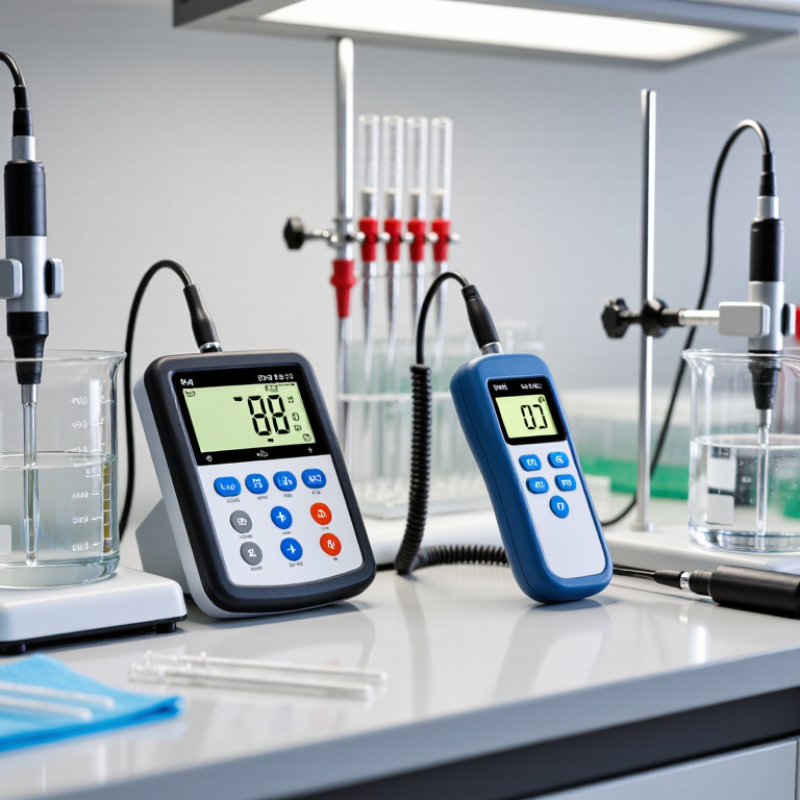
2026 How to Choose the Best Conductivity Meter

Determine the Measurement Purpose and Testing Environment

Before choosing a conductivity meter, define what the reading must tell you. A stream survey, a reverse-osmosis check, and a concentrated process solution require different measurement ranges and probe designs. The USGS Water Science School reports that freshwater-stream conductivity commonly falls between 50 and 1,500 µS/cm. That broad span is useful for context, not a pass-or-fail limit. Match the meter’s range and resolution to your expected samples, and check whether it reports conductivity, specific conductance, or salinity. These values are related, but they are not interchangeable.

Consider the test site as carefully as the sample. The USGS National Field Manual describes measuring specific conductance with temperature compensation to 25°C, because readings change with temperature. For outdoor work, a sealed, portable meter and a clear calibration routine can help manage rain, dust, and changing sample temperatures. In a lab, a benchtop unit may suit repeated measurements; narrow beakers can still make probe placement awkward. Small details matter. Rinse the cell between samples, remove trapped bubbles, and let the reading stabilize. A meter with automatic compensation cannot correct a contaminated probe or an unsuitable calibration standard. I would also record sample temperature and units—easy to skip when several bottles are waiting.

Match the Meter’s Range to Your Sample and Accuracy Needs

A conductivity meter should cover the values you expect to measure, not just the widest range available. Drinking water may sit in the low microsiemens-per-centimeter range, while concentrated process solutions can reach much higher levels. Check the sample’s likely minimum and maximum before choosing. If readings cluster near the bottom of a meter’s range, small changes may be harder to distinguish. If they approach its upper limit, the display may show an over-range warning. Close matters.

Tips: Compare the meter’s range, resolution, and stated accuracy with your target values. Resolution is the smallest displayed step; it is not the same as accuracy. Choose calibration standards near the values you expect to test, and check whether the meter supports temperature compensation. Rinse the probe between samples to reduce carryover.

The range choice is not always obvious, especially when samples vary by season or production batch. A wider-range instrument can offer flexibility, but it may not provide the detail needed for low-level measurements. Read the specifications for each range, since accuracy can differ across them. Also consider the sample itself: dirty or coating-prone probes can cause unstable readings, regardless of the meter’s stated precision. Record temperature and calibration details with results. It is easy to overlook those notes.

2026 How to Choose the Best Conductivity Meter - Match the Meter’s Range to Your Sample and Accuracy Needs

Sample or Application Typical Conductivity at About 25°C Useful Measurement Range Suggested Meter Range Practical Accuracy Goal Cell and Measurement Considerations
Ultrapure water Approximately 0.055 μS/cm at the theoretical limit for pure water About 0.05–1 μS/cm A low-conductivity instrument covering roughly 0.01–20 μS/cm About ±1–2% of reading, when the meter, cell, temperature control, and sampling method support it Use a clean, suitable low-constant cell, commonly around 0.01–0.1 cm−1. Minimize air exposure because dissolved carbon dioxide quickly increases the reading.
Distilled or deionized water Often roughly 0.5–10 μS/cm; actual values depend on water quality and exposure to air About 0.1–20 μS/cm A low-range meter covering at least 0.1–200 μS/cm About ±1–2% of reading for controlled, repeatable measurements A low-constant cell improves sensitivity. Rinse the cell with the sample and avoid contamination from containers, handling, or residual rinse water.
Freshwater, drinking water, and general laboratory solutions Commonly about 50–1,500 μS/cm, with substantial variation by source and dissolved ions About 10–5,000 μS/cm A meter covering approximately 0–20 mS/cm About ±1% of reading is a useful target for routine testing A cell constant near 1 cm−1 is often suitable. Check that the meter’s temperature compensation is appropriate for the solution.
Hydroponic nutrient solution and moderately concentrated process water Often about 0.5–5 mS/cm, depending on the formulation and operating conditions About 0.1–10 mS/cm A meter covering at least 0–20 mS/cm About ±1–2% of reading is generally practical for routine monitoring A cell constant near 1 cm−1 is commonly appropriate. Measure at a consistent temperature or use a documented compensation setting.
Brackish water and concentrated industrial solutions Often about 5–50 mS/cm; the value depends on composition and temperature About 1–100 mS/cm A meter covering at least 0–200 mS/cm About ±1–2% of reading, provided the cell is used within its validated range A higher-constant cell, often around 10 cm−1, may be useful. Verify chemical compatibility and prevent carryover between samples.
Seawater and high-salinity samples Approximately 50–55 mS/cm for typical ocean water near 35 practical salinity units at 25°C About 10–100 mS/cm A meter covering at least 0–200 mS/cm; choose a salinity-capable system if salinity is the reported result For conductivity, about ±1% of reading is a useful target; salinity accuracy also depends on the conversion method and temperature measurement Use a cell designed for high conductivity and a temperature sensor suited to the application. Conductivity-to-salinity conversion depends on the sample and applicable standard.

Selection note: Values are typical guidance, not universal specifications. Natural waters, formulations, temperature, contamination, and measurement procedures can change results. Choose a meter whose specified range includes the expected sample values with adequate resolution, and confirm accuracy specifications at the measurement range and temperature you will use.

Compare Probe Types, Compensation, and Measurement Features

2026 How to Choose the Best Conductivity Meter

Compare Probe Types, Compensation, and Measurement Features

Choose a probe for the samples you actually test. Two-electrode probes suit many routine measurements, while four-electrode designs can handle wider conductivity ranges with less polarization. Inductive probes are useful for corrosive or dirty samples because their sensors avoid direct electrode contact. Check the expected range, sample temperature, and cleaning routine before buying. A probe that looks versatile may still be awkward in a narrow sample bottle.

Temperature compensation deserves close attention. USGS field guidance uses a 1.91% per °C coefficient as a common correction for natural waters, but sample chemistry can shift that response. Automatic compensation is convenient, not magic. Confirm the reference temperature, usually 25°C, and whether the meter allows a suitable compensation coefficient. ASTM D1125 provides recognized test methods for water conductivity and resistivity; its procedures reinforce the value of calibration and consistent technique. A stable reading indicator and data logging also help when comparing samples across locations.

Tips: Rinse the probe with sample water, remove trapped bubbles, and wait for the reading to settle. Record temperature and calibration details with each result. Even careful measurements can drift—inspect the cell constant and recalibrate when checks fail.

Assess Calibration, Data Handling, and Ease of Use

2026 How to Choose the Best Conductivity Meter
Assess Calibration, Data Handling, and Ease of Use

Calibration quality matters more than a crowded feature list. NIST reference data give 0.01 mol/kg potassium chloride a conductivity of 1.40823 mS/cm at 25°C. Check that the meter supports standards near your samples’ expected range. For water near 1,400 μS/cm, a matching standard makes a useful check. Rinse the probe between solutions, and wait for readings to stabilize. Small habits matter.

Data handling should preserve the details behind each result. The USGS National Field Manual reports specific conductance normalized to 25°C, making temperature handling important when comparing measurements. Look for clear temperature-compensation settings, time-stamped records, and simple exports. A spreadsheet-friendly file helps, but only if sample IDs and units remain attached. Test the export before relying on it. I have seen tidy-looking records become hard to interpret when units were missing.

Ease of use shows up during repetitive work. Can you calibrate with wet gloves? Is the display readable beside a sink? A probe that rinses clean and stores safely can save time across a full shift. Check replacement probe availability and the manual’s maintenance instructions, too. No meter removes operator error; even a good instrument needs careful handling. I would still compare its readings with a second check before trusting an unexpected result.

2026 How to Choose the Best Conductivity Meter

Assess calibration support, data handling, and ease of use.

Common calibration standards at 25°C span low to high conductivity. Choose a meter and standards that bracket your sample range, and check the standard’s certificate for its specified value and temperature. For data handling, look for clear export options and traceable readings; for ease of use, assess calibration prompts, temperature compensation, and probe maintenance.

Check Durability, Support, and Total Ownership Costs

2026 How to Choose the Best Conductivity Meter

Check Durability, Support, and Total Ownership Costs

A meter’s purchase price is only one part of its cost. U.S. Department of Energy Federal Energy Management Program life-cycle-costing guidance includes acquisition, operation, maintenance, replacement, and disposal costs. Apply that lens to meters: estimate calibration supplies, service time, spare probes, and downtime across the expected service life. A low-cost unit may become expensive if its sensor drifts or replacement parts are hard to obtain. Check whether the supplier offers repair, calibration, and technical support, and confirm typical turnaround times in writing.

Durability should match the actual workspace. A meter used beside a wet process line faces splashes, knocks, and frequent cleaning; a bench unit may need less physical protection. Review the stated ingress rating, operating temperature range, warranty exclusions, and probe replacement options. ASTM D1125 provides standard methods for measuring water conductivity, but reliable readings still depend on suitable calibration and careful sample handling. The U.S. DOE’s Operations & Maintenance Best Practices Guide notes that reactive maintenance can cost three to four times more than proactive maintenance in facility settings. That is not a meter-specific estimate, but it shows why planned checks matter.

Small details count.

Tips: Compare three-year costs, not just quotes. Ask for service rates, spare-part prices, and calibration instructions. Then test the meter with your own samples before buying. Specs can look convincing. In practice, a short field trial may expose awkward menus or fragile cables—details that are easy to miss on paper.