What Are the Top 10 Composite Wall Panels for Buyers?
Choosing the right Composite Wall Panels involves more than comparing colors, prices, or surface finishes. Buyers must examine thermal performance, moisture resistance, fire behavior, acoustic control, impact strength, and installation requirements. A panel that performs well in a dry warehouse may fail in a humid coastal building. Context matters.
Building scientist Dr. Joseph Lstiburek has often emphasized, “The perfect wall is an environmental separator.” This principle offers a useful starting point. Composite Wall Panels should help control heat, water, air, and vapor while supporting the building’s intended use. The best options also include clear technical data, tested assemblies, dependable warranties, and practical maintenance guidance. Product literature alone is not enough. Ask how the panel performs at joints, corners, penetrations, and exposed edges.
This guide reviews ten leading panel types for informed buyers. It considers insulated metal panels, aluminum composite panels, fiber cement systems, high-pressure laminate panels, and other widely used solutions. Each option has strengths and compromises. Some provide excellent insulation but require careful detailing. Others offer attractive finishes yet demand stronger substrate preparation. No ranking can suit every project.
Real-world experience still matters. A sample panel may look impressive under showroom lighting, then reveal glare, scratching, or difficult cutting on site. Buyers should request samples, installation drawings, test reports, and references from comparable projects. The final decision should balance performance, appearance, budget, climate, and long-term service needs. Small details often decide large outcomes.
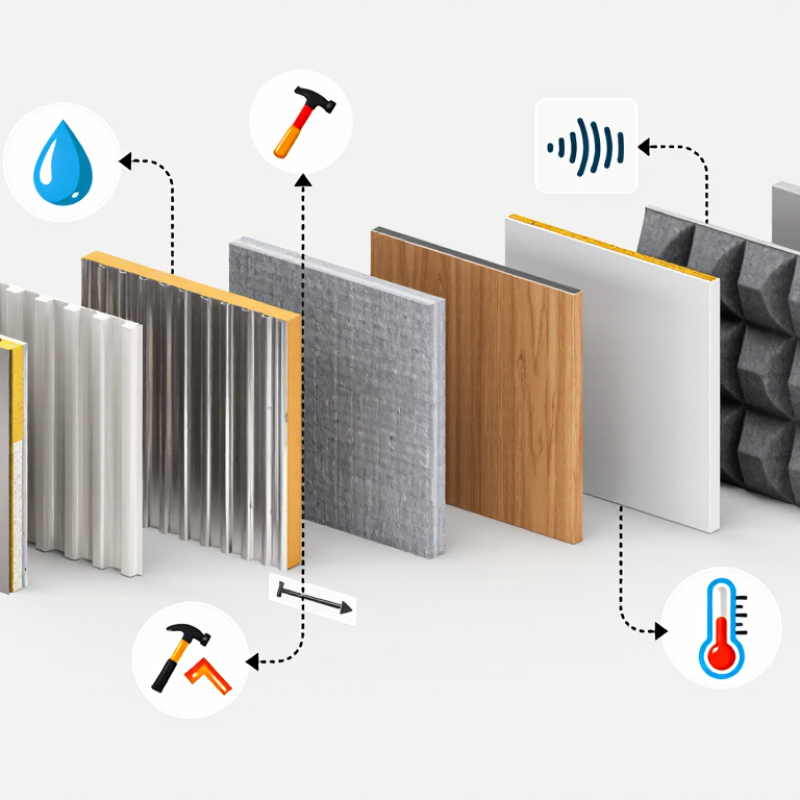
What Are Composite Wall Panels and How Are They Classified?
Composite wall panels combine two or more materials into one building element. A typical panel has outer skins, an insulated core, and an adhesive or mechanical connection. This layered structure can reduce installation time while improving thermal performance and surface durability. It starts with structure. Buyers should check panel thickness, joint design, weight, and load requirements before comparing prices.
The clearest classification uses the core material. Mineral wool panels offer strong fire resistance and sound control. PIR panels usually provide high insulation within a thinner profile. EPS panels can be lightweight and economical, but their fire performance requires careful verification. Some panels use polyurethane, recycled cores, or honeycomb structures for specific performance needs. Classification is not perfectly tidy. A panel may belong to several groups.
Panels can also be classified by facing material and application. Aluminum-faced products suit clean industrial walls and controlled interior conditions. Steel-faced panels are common where impact resistance and easy cleaning matter. Fiber-cement or magnesium-based boards may support ventilated façades and demanding weather exposure. Buyers should also separate indoor, exterior, cold-storage, acoustic, and fire-rated categories. Field experience shows that poor joint detailing often causes more trouble than the panel itself. Check tested fire ratings, water resistance, thermal values, and installation limits. Details matter. Some product data appears impressive, yet real performance can decline when fasteners, corners, or seals are chosen poorly.
What Features Should Buyers Evaluate Before Choosing a Panel?
Choosing among the top 10 composite wall panels requires more than comparing surface colors. Buyers should inspect the core, skins, and joining system. A dense core can improve impact resistance, while a lighter panel may simplify installation. Check thermal conductivity and acoustic ratings for the building’s actual location. Moisture exposure matters too. A panel used near wash areas needs reliable edge protection and sealed joints.
Ask for independent test reports covering fire performance, wind load, water resistance, and dimensional stability. Do not rely only on a sales sheet. Compare the stated results with your project’s requirements and local construction standards. Review panel thickness, module size, fasteners, and replacement procedures. Small details can affect labor costs. In my experience, installers often notice alignment problems before buyers do. That practical feedback deserves attention.
Tips: Request physical samples. Examine the cut edge. Test the locking fit. Ask how the surface handles scratches, stains, and sunlight. Confirm cleaning instructions and expected service life. Check whether spare panels can be ordered later. Also compare the full installed cost, not just the panel price. A cheaper option may require more framing or specialized tools. I would also allow time for a mock-up, although this step is sometimes skipped. That omission can create expensive surprises. Record every test result and promise in writing.
What Are the Top 10 Composite Wall Panels for Buyers?
Choosing among the top 10 composite wall panels depends on climate, budget, and installation skill. Aluminum composite panels suit clean facades and light commercial buildings. Wood-plastic panels offer warm textures with limited routine maintenance. Fiber-cement composite panels handle moisture and impact well. Stone-plastic panels can imitate masonry at a lower weight. Aluminum honeycomb panels provide stiffness for larger surfaces. Phenolic panels support strong thermal performance in demanding interiors. Magnesium-oxide composite panels resist fire, but moisture protection deserves careful checking. Glass-fiber reinforced panels work well in busy corridors and industrial spaces. Bamboo composite panels add a natural appearance, though color may change over time. Insulated sandwich panels combine facing layers with a thermal core.
Tips: Request full technical sheets, not only samples. Compare panel thickness, core density, fire rating, water absorption, and tested impact resistance. Check whether the fixing system suits concrete, steel, or timber walls. Measure joints carefully. Small errors become visible quickly. Ask for installation instructions and maintenance requirements before purchasing. A local installer’s experience can reveal problems that brochures miss.
In practical projects, I have found that surface appearance often hides construction differences. Two panels may look identical, yet their cores can perform differently in heat or humidity. Some ratings also depend on the complete wall assembly, not the panel alone. That detail is easy to overlook. Buyers should examine warranties, test dates, edge finishing, and replacement availability. A cheaper panel may become expensive after difficult cutting, damaged corners, or frequent cleaning. No option is perfect. The right choice balances verified performance with realistic site conditions.
How Do the Top Panel Types Compare in Cost and Performance?
Choosing among the top ten composite wall panels depends on installed cost, climate, maintenance, and fire requirements. Material prices alone can mislead buyers.
Aluminum composite panels usually offer a mid-range cost and clean, durable surfaces. They suit commercial façades but may dent under strong impact. Fiber-reinforced plastic panels cost moderately and resist moisture well. Their appearance can feel industrial. Glass-reinforced panels provide similar strength, with better options for molded textures. Insulated metal panels often reduce labor costs because the insulation is built in. However, joints require careful sealing. Mineral-wool panels cost more than basic insulated panels but deliver strong fire performance and sound control. They are heavier, which can increase installation time.
Expanded-polystyrene panels are often among the lowest-cost choices. They provide useful insulation, but fire ratings and impact resistance need close checking. Polyurethane panels usually cost more, while offering stronger thermal performance with thinner profiles. Polyisocyanurate panels may perform better in demanding thermal applications, though price and availability vary. Phenolic panels are highly efficient but can be expensive and less forgiving during cutting. Wood-plastic composite panels create a warm appearance and resist rot, yet they may expand noticeably with temperature. Fiber-cement composite panels offer good weather resistance and a solid finish, but their weight raises framing and labor costs.
From site experience, the cheapest panel rarely produces the lowest project cost. Fast installation can outweigh a higher purchase price. Still, published performance figures do not always match poorly sealed joints or uneven substrates. I would request tested fire data, thermal values, warranty conditions, and sample panels before approving a large order.
What Are the Top 10 Composite Wall Panels for Buyers?
The chart compares representative installed material costs and an indicative performance index for common composite wall panel types. Costs are approximate 2025 market ranges converted to midpoint values in USD per m²; performance scores combine thermal efficiency, moisture resistance, durability, fire behavior, and maintenance requirements on a 1–10 scale.
Lower-cost panels such as PVC foam and FRP can suit basic interior or moisture-resistant applications, while phenolic insulated, GFRP, and insulated metal panels generally provide stronger overall performance. Final pricing varies by thickness, insulation core, fire rating, finish, quantity, labor, and local market conditions.
How Can Buyers Select the Right Composite Wall Panel?
Choosing among the top ten composite wall panels starts with the building’s actual demands, not attractive catalog photos. Consider moisture, impact, fire performance, insulation, sound control, and expected service life. A panel for a humid bathroom needs different protection from one used in a busy warehouse.
Check the core, facing material, thickness, joint design, and surface finish. Ask for independent test reports, installation instructions, maintenance requirements, and warranty conditions. On site, I have seen small joint gaps cause major moisture problems. Sample panels should be inspected under strong light and handled before ordering. Look for flat edges, consistent color, firm bonding, and realistic texture. The cheapest option may create higher labor costs later.
Tips: Compare samples in the real room. Test cleaning resistance. Confirm panel weight and fixing methods. Check whether local installers understand the system. Do not rely on one performance number. A panel with excellent insulation may offer poor impact resistance. Another may look durable but scratch easily. Buyers should record these compromises in a simple comparison sheet. I would also question unclear claims. Some decisions remain uncertain until the panel meets the wall, tools, climate, and daily use.



 Distributors
  SDS Download
  Contact