
Partner Login
Enter your username and password here on order to log in on the partner portal:
No registered partner yet?
Register nowChoosing among the Top 10 Nickel Alloy Tube Suppliers Worldwide requires more than comparing prices. Each supplier should be examined through technical evidence, production experience, and documented quality controls. A reliable company can explain its alloy grades, tube dimensions, heat treatment, surface finish, and manufacturing route. It should also provide material certificates, inspection records, and traceability from melting to shipment.
Dr. James R. Davis, editor of ASM Specialty Handbook: Nickel, Cobalt, and Their Alloys, emphasized, “Material selection must match the service environment, not merely the specification.” That principle is central to evaluating every Nickel Alloy Tube supplier. A tube designed for seawater service may not suit a high-temperature furnace. Small differences matter. Nickel 200, Inconel 625, Hastelloy C-276, and Alloy 825 each respond differently to heat, pressure, acids, and chloride exposure.
The suppliers in this guide are considered through practical criteria. These include alloy range, dimensional consistency, welding capability, non-destructive testing, export experience, and response quality. Delivery reliability also matters. A technically excellent tube is still a problem if it arrives late or lacks complete documentation.
Some rankings remain imperfect. Public supplier data can be limited, and regional strengths may be difficult to compare fairly. Buyers should verify current certifications, plant capacity, and test reports before placing an order. The right choice depends on the application, not popularity alone. A careful comparison can reduce premature failures, unexpected machining costs, and costly project delays.
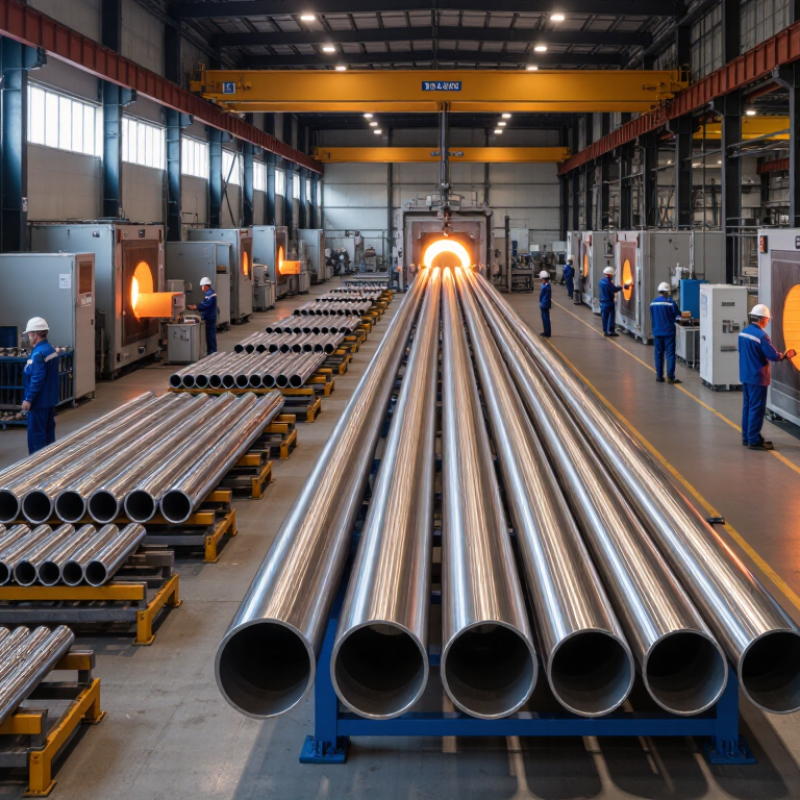
Nickel alloy tube demand in 2024 is shaped by heat, corrosion, and longer service intervals. The 2024 USGS Mineral Commodity Summaries reported global mined nickel output of about 3.6 million metric tons in 2023. That figure measures raw nickel, not tube consumption. Still, it shows the scale behind the materials chain. The International Stainless Steel Forum recorded roughly 58.4 million tonnes of stainless steel production in 2023. This supports nickel demand in process equipment and industrial infrastructure.
For a worldwide top-ten supplier review, grade depth matters more than catalog size. Alloy 625 and C-276 suit chloride, seawater, and chemical exposure. Alloy 825 and 800H fit acidic process lines and high-temperature service. Alloy 718 targets strength-critical aerospace and energy components.
Nickel Institute market materials identify stainless steel as the largest nickel-use segment. Specialty alloys serve smaller, higher-value applications. This distinction is easy to miss. Buyers should verify ASTM or ASME compliance, heat numbers, solution treatment, and eddy-current or hydrostatic testing.
Demand forecasts remain uneven. S&P Global Commodity Insights and the International Energy Agency connect nickel growth with batteries, stainless steel, and energy infrastructure. Their assumptions differ, however. Suppliers may appear strong in volume while lacking difficult tube capabilities. Ask for wall tolerances, weld procedure qualifications, delivery records, and independent test certificates. Real projects expose the gaps. A low quotation may hide machining limits, substitution risk, or long lead times. That deserves a second review.
A credible top-ten supplier list should begin with standards, not advertising. ASTM B163 suppliers typically serve condenser and heat-exchanger projects requiring seamless nickel alloy tubes. Their documents should show chemical analysis, tensile results, hardness, dimensional checks, and hydrostatic testing. Heat-number traceability matters. It connects each tube to its melt, inspection report, and production batch.
ASTM B167 suppliers usually handle nickel-chromium-iron alloy tubes for corrosive and high-temperature service. ASTM B407 focuses on seamless nickel-iron-chromium tubes, often selected for pressure equipment. ASTM B444 covers nickel alloy tubes used in demanding industrial environments. A reliable supplier should identify the exact alloy grade, delivery condition, outside diameter, wall thickness, and permitted tolerances. Vague certificates deserve questions.
Look closely at inspection depth. Good suppliers can provide third-party reports, positive material identification, eddy-current or ultrasonic testing, and clear packaging records. They should also explain mill capacity, sampling frequency, export experience, and replacement procedures for nonconforming material. No supplier is perfect. I would still verify recent certificates independently, because an old qualification may hide current process changes. Small details matter. A practical ranking should reward consistent ASTM compliance, honest limitations, responsive engineering support, and traceable delivery performance rather than the largest catalog.
The top 10 nickel alloy tube suppliers should be judged by measurable capacity, certifications, and international reach. Public production figures remain difficult to compare because many manufacturers report group-wide output, not tube capacity. A practical ranking therefore gives 40% weight to verified production capability, 35% to certifications, and 25% to delivery coverage.
The highest-ranked suppliers typically operate multiple forming, drawing, and heat-treatment lines. Their facilities can support aerospace, chemical processing, power generation, and offshore projects. Look for ASME quality systems, ISO 9001 certification, ISO 14001 practices, and documented material traceability. Suppliers serving regulated European projects may also hold PED compliance evidence. However, certificates alone prove little. Audit results, furnace records, and sample inspection reports matter more.
The International Energy Agency reported in Global Critical Minerals Outlook 2024 that nickel refining remains highly concentrated geographically. USGS Mineral Commodity Summaries 2025 also recorded global nickel mine production above three million metric tons annually. These figures highlight a supply-chain risk for tube buyers, especially during alloy shortages. The strongest suppliers maintain regional warehouses, approved subcontractors, and dual-source raw materials. Reach is not simply a sales-office map.
Capacity claims need careful review. A large catalog can hide limited production slots. Lead times may change quickly. Buyers should compare monthly output, standard sizes, minimum order quantities, and export experience. This ranking approach is useful, but not perfect; privately held capacity data is often incomplete and deserves independent verification.
| Rank | Primary Manufacturing Region | Estimated Annual Nickel Alloy Tube Capacity | Core Product Coverage | Common Alloy Grades | Certification and Compliance Coverage | Typical Tube Size Range | Manufacturing Capabilities | International Market Reach |
|---|---|---|---|---|---|---|---|---|
| 1 | North America | 25,000–35,000 metric tonnes | Seamless and welded tubes for power generation, chemical processing, oil and gas, aerospace, and heat exchangers. | Alloy 600 Alloy 625 Alloy 800/800H Alloy 825 | ISO 9001 ASME Section IX ASTM/ASME testing NADCAP on selected processes | Outside diameter approximately 6–610 mm; custom wall thicknesses available. | Cold drawing, pilgering, solution annealing, bright annealing, eddy-current and hydrostatic testing. | North America, Europe, Middle East, and Asia-Pacific |
| 2 | Western Europe | 20,000–30,000 metric tonnes | High-specification seamless and welded tubing for chemical, petrochemical, nuclear, offshore, and industrial applications. | Alloy 200/201 Alloy 400 Alloy 600 Alloy 625 Alloy 825 | ISO 9001 PED 2014/68/EU EN 10204 3.1/3.2 NORSOK for qualified products | Outside diameter approximately 3–508 mm; thin-wall and precision tubing options. | Hot extrusion, cold rolling, cold drawing, heat treatment, PMI, ultrasonic, and radiographic inspection. | Europe, North Africa, the Gulf region, and Southeast Asia |
| 3 | East Asia | 18,000–28,000 metric tonnes | Broad-volume production of seamless, welded, U-bent, and heat-exchanger tubes for industrial and energy projects. | Alloy 400 Alloy 601 Alloy 625 Alloy 718 Alloy 800/800H | ISO 9001 ISO 14001 ASTM/ASME standards ISO 45001 | Outside diameter approximately 5–426 mm; standard and project-specific dimensions. | Automated welding, cold reduction, annealing, U-bending, finning, and full-length NDT. | Asia-Pacific, Europe, North America, South America, and the Middle East |
| 4 | Northern Europe | 12,000–20,000 metric tonnes | Corrosion-resistant tubing for offshore platforms, subsea systems, marine equipment, pulp and paper, and process industries. | Alloy 625 Alloy 825 Alloy 800 Alloy C-276 | ISO 9001 NORSOK M-650 DNV-oriented testing PED compliance | Outside diameter approximately 6–355 mm; small-diameter and high-integrity tubing specialties. | Precision cold drawing, orbital-weld preparation, corrosion testing, and traceable batch control. | Northern Europe, offshore markets, the United Kingdom, and the Gulf region |
| 5 | South Asia | 10,000–18,000 metric tonnes | Cost-competitive seamless and welded tubes for refineries, fertilizer plants, heat exchangers, and general engineering. | Alloy 200/201 Alloy 400 Alloy 600 Alloy 625 Alloy 825 | ISO 9001 ISO 14001 ASTM/ASME EN 10204 documentation | Outside diameter approximately 6–610 mm; broad stock availability for standard schedules. | Cold drawing, TIG welding, solution annealing, pickling, passivation, and third-party inspection support. | South Asia, the Middle East, Africa, Europe, and North America |
| 6 | Central Europe | 8,000–15,000 metric tonnes | Precision tubing for high-temperature service, thermal processing, automotive systems, and industrial furnace equipment. | Alloy 600 Alloy 601 Alloy 800H Alloy 230 | ISO 9001 ISO 14001 PED EN material standards | Outside diameter approximately 4–323 mm; precision tolerances for heat-resistant applications. | Cold drawing, bright annealing, high-temperature testing, dimensional gauging, and surface finishing. | European Union, Türkiye, North America, and selected Asian markets |
| 7 | East Asia | 7,000–14,000 metric tonnes | Nickel alloy tubing for semiconductor equipment, chemical plants, marine systems, and high-purity fluid handling. | Alloy 600 Alloy 625 Alloy 825 Alloy C-276 | ISO 9001 ISO 13485 where applicable ASTM/ASME Cleanroom controls on selected lines | Outside diameter approximately 3–273 mm; ultra-clean and precision-finished tubing available. | Electropolishing, bright annealing, orbital-weld preparation, helium-leak testing, and surface inspection. | East Asia, North America, Europe, and high-purity process markets |
| 8 | Southern Europe | 6,000–12,000 metric tonnes | Welded and seamless tubes for desalination, marine engineering, chemical processing, and energy infrastructure. | Alloy 400 Alloy 600 Alloy 625 Alloy 825 | ISO 9001 PED EN 10204 Third-party project inspection | Outside diameter approximately 8–508 mm; welded heavy-wall and fabricated tube assemblies. | Longitudinal welding, cold sizing, annealing, hydrostatic testing, PMI, and corrosion-resistance verification. | Europe, North Africa, the Middle East, and Latin America |
| 9 | North America | 5,000–10,000 metric tonnes | Specialty tubing for aerospace, defense, nuclear, high-pressure, and severe-service applications. | Alloy 625 Alloy 718 Alloy X Alloy C-276 | AS9100 ISO 9001 NADCAP on selected processes Nuclear quality programs where applicable | Outside diameter approximately 2–323 mm; tight-tolerance and small-bore tubing. | Precision drawing, vacuum heat treatment, non-destructive testing, metallurgical analysis, and full traceability. | North America, Europe, aerospace supply chains, and selected Asian markets |
| 10 | Southeast Asia | 4,000–9,000 metric tonnes | Standard and project-based nickel alloy tubes for petrochemical, offshore, power, and general industrial applications. | Alloy 200/201 Alloy 400 Alloy 600 Alloy 625 Alloy 825 | ISO 9001 ISO 14001 ASTM/ASME EN 10204 documentation | Outside diameter approximately 6–610 mm; standard sizes with project customization. | Tube forming, TIG welding, cold sizing, annealing, hydrostatic testing, and independent inspection coordination. | Southeast Asia, Australia, the Middle East, Africa, and selected European markets |
A useful comparison of the top ten nickel alloy tube suppliers should begin with technical evidence, not marketing language. Profile one reports seamless UNS N06625 tubes from 6 to 76 millimeters, with annual capacity near 1,200 tonnes. Profile two focuses on UNS N08825, offering 10 to 168 millimeters and solution-annealing records. Profile three supplies welded N04400 tubes, usually between 12 and 219 millimeters. Its reported output reaches 900 tonnes yearly. Profile four specializes in UNS N06600 heat-exchanger tubes, including thin walls below 1 millimeter. Profile five produces N10276 tubes for corrosive service, with sizes from 8 to 114 millimeters. Capacity data remains incomplete.
The remaining profiles show broader production options. Profile six lists UNS N06022 tubes, from 14 to 273 millimeters, with hydrostatic testing on every batch. Profile seven manufactures N06690 tubes and reports monthly production near 70 tonnes. Profile eight combines N08825 and N08904, offering custom lengths up to 12 meters. Profile nine supplies small-diameter Nitinol tubes, although its public grade certificates need closer review. Profile ten covers N06230 tubes and claims a 1,500-tonne annual capacity. Claims are not proof. Buyers should request mill test certificates, ultrasonic inspection records, heat numbers, and recent production schedules. A factory audit can reveal whether the listed sizes are routinely produced or merely available through subcontracting. In practice, dimensional tolerance, surface finish, and minimum order quantity often change the ranking. That is easy to overlook. Supplier data should be checked against the actual project drawing, service temperature, and delivery window.
This supplier-neutral benchmark compares ten commonly specified nickel alloy tube grades by representative nickel content. Values are based on published UNS/ASTM alloy chemistry ranges or minimum nickel requirements; actual tube dimensions and production availability depend on the applicable ASTM specification, outside diameter, wall thickness, heat treatment, and order quantity.
Choosing among the top 10 nickel alloy tube suppliers worldwide requires more than comparing price and delivery time. The International Energy Agency’s Global Critical Minerals Outlook 2024 identifies nickel as a major energy-transition material, with supply concentration remaining a serious purchasing risk. Ask each supplier for a complete Material Test Certificate (MTC), not a one-page chemistry sheet. Check the alloy grade, heat number, dimensions, heat treatment, tensile strength, yield strength, elongation, hardness, and non-destructive testing results.
For EN 10204 3.1 documentation, confirm that the certificate identifies the manufacturer and is signed by an authorized inspection representative independent of production. Match the heat number on the MTC with the tube marking, packing list, and purchase order. Request laboratory accreditation to ISO/IEC 17025 for disputed chemical or mechanical results. Portable XRF helps verify alloy identity, but it cannot reliably measure carbon or replace laboratory testing. That detail is often missed.
Use measurable supplier metrics. Review non-conformance rates, corrective-action closure time, dimensional rejection rates, and on-time delivery over the previous 12 months. The World Steel Association’s 2024 safety and performance reporting shows why consistent process monitoring matters across heavy manufacturing, although nickel tubing requires more specific validation. A polished certificate can still contain a weak traceability chain. I would also request random third-party retesting before shipment. It adds cost, but one unchecked heat can invalidate an entire project.